


Ever since I started testing tools like Clothoff, Pornworks, Seduced, and others, back in the day, I’ve always asked myself: “Okay, this generation looks great, but will it be able to recreate it exactly the same way with a few changes – like, say, the scene?” Until recently, the answer was always the exact opposite of what I actually wanted to hear…obviously not. Great creations–ask for a small change–and you get a completely different persona/subject. Maybe even a nice generated image, but completely different.
And that often undermines the professional need to have multiple multimedia assets featuring the same subject but for different applications; in 2026 it’s becoming the thing the entire category is competing on.
Randomic outputs are fine for browsing. It’s useless the moment you want to build anything: a recurring character, a story, a companion you come back to. The future the good tools are racing toward is the opposite of the slot machine. It’s persistence.
What “persistent character” actually means
A persistent character is a fictional person the system can reproduce on demand: same face, same body, same vibe, across a dozen images, a chat, and, increasingly, video. You define them once and they stop being a lucky roll you can never get back. That’s the whole game. Consistency is what turns generation into a relationship with a creation, instead of an endless parade of one-night strangers your model immediately forgets.
It’s also genuinely hard, which is why so few tools nailed it early. Diffusion models are, by nature, forgetful, every generation is a fresh draw. Pinning an identity across draws, across modalities, across a long chat without the character drifting into someone else is a real engineering problem. The tools getting it right aren’t doing it by accident.
Why it matters more than “better images”
The instinct is to assume the next leap in this space is sharper, more realistic output. It isn’t. Image quality is already past the point of diminishing returns for most people– we crossed “good enough to be indistinguishable at a glance” a while ago. The frontier moved. What people actually want next isn’t a prettier stranger; it’s the same person again.
Think about what persistence unlocks. A companion app where she remembers what she looked like yesterday. A creator who can build an entire fictional catalog around one recognizable face. A chat that can send you an image and have it actually be the character you’ve been talking to, not a random model in a wig. Every one of those is a persistent-character problem, and every one of them is worth more to a user than another half-percent of realism.
Who’s betting on it
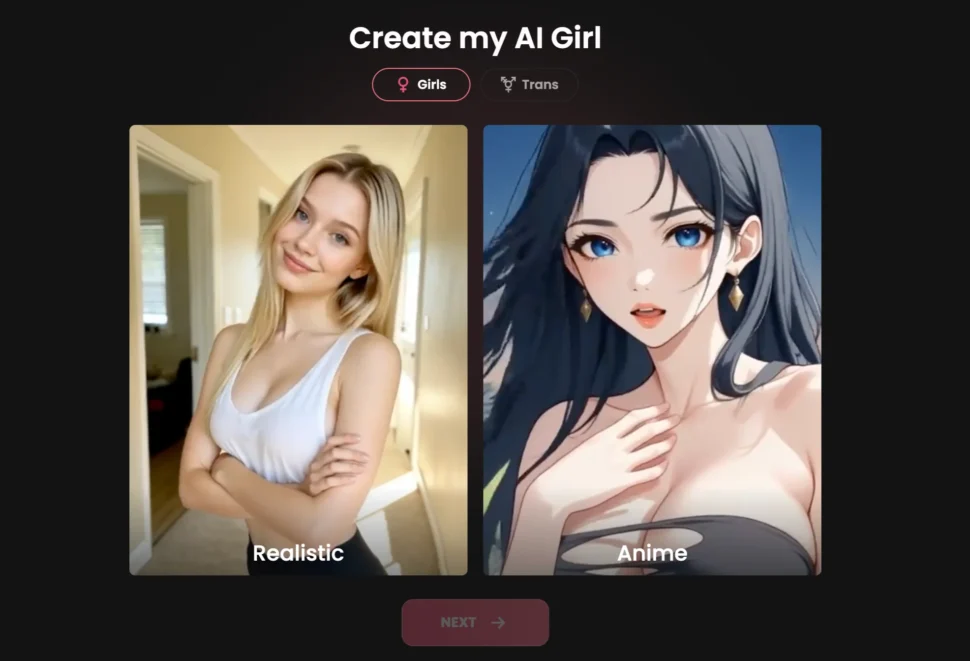
The companion and “AI girlfriend” tools were here first, because their entire premise depends on it, a companion who looks different every time isn’t a companion. Candy.ai, DreamGF, CrushOn and OurDream all live or die on whether their character stays themselves across a conversation and the images that conversation produces. When one of them feels alive, persistence is usually why.
What’s newer and more telling, is the pure image and undress tools racing to add it. When a prompt-based generator ships a “characters” feature, that’s the signal that the category has accepted the thesis. The current xNudes, for instance, added a Characters mode (still in beta at the time of trying) precisely because a generator that can only make strangers is a generator with a ceiling. The ones that can make your character have somewhere to grow.

What to look for before you buy
If persistence is the feature that matters, here’s how I’d pressure-test it rather than take a feature list at its word:
- Make the character, then make them again in a different pose and setting. Does the face survive? The body type? Or did you get a cousin?
- Cross modalities. If the tool does chat and images, ask the character for a picture mid-conversation. If the image ignores everything you’ve established, the “character” is cosmetic.
- Push the length. Consistency that holds for three generations and falls apart by ten isn’t consistency. The drift is where these systems show their seams.
In 2026 every day we discover that this feature is being added to both old or new sites. I’m fairly confident in it: the tools that win won’t be the ones with the highest-resolution single image. They’ll be the ones where the person you made yesterday is still there today. Realism got commoditized. Memory didn’t. That’s where the next round of this fight gets decided, and it’s the sort of ordering in my list now.