

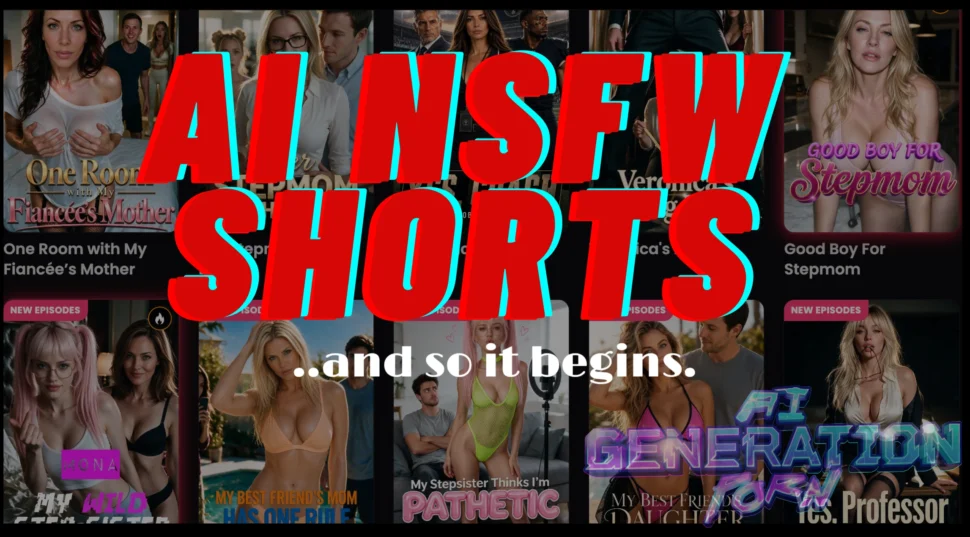
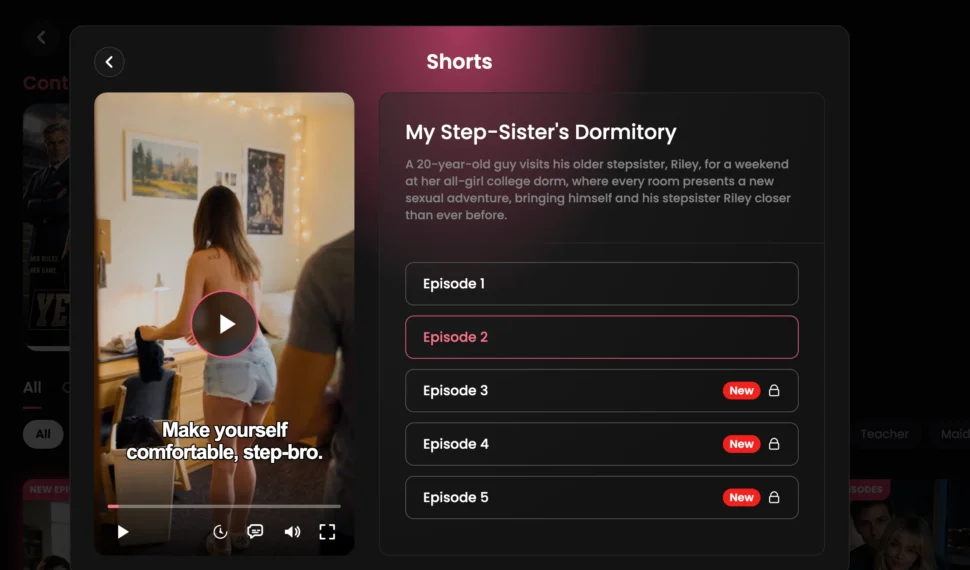
Open Candy.ai right now and the new thing you’ll notice it is a wall of posters! “NEW EPISODES” badges in the corner, a filter row that reads Stepsister, Milf, Cuckold, Nympho, Stepmom, Wife, Taboo, Fantasy, Teacher, Maid, and title cards with the kind of typography a real streaming service pays an agency for. My Step-Sister’s Dormitory. I Couldn’t Say No to Our Babysitter. My Young Stepmom Needs a Date. Yes, Coach.
It looks like someone built an NSFW Netflix. That is not what it is, and the difference is the most interesting thing happening in this category right now. Below is the state of AI porn shorts in 2026: which sites actually have them, what each one really gives you, and which are free to start.
Best AI Porn Shorts 2026: Quick Comparison
- Candy.ai: episodic series plus licensed digital twins of real performers, and now Candy Studio to direct your own. The deepest catalogue of the five.
- Secrets.ai: bingeable mini-dramas starring your own companions. New episodes weekly, free to start.
- Lovescape: not shorts at all. Full explicit scenes running up to roughly 12 minutes.
- OurDream.ai: Opening Scenes that set a situation and hand you straight into the chat.
- Swipey.ai: seasons and numbered episodes built inside the chat itself. Quality below the others.
Names above go straight to the platform. The table below has the same five side by side, with our full review linked from each name.
The best AI porn shorts sites, side by side
Before the analysis, the practical part. Five platforms now ship something they call shorts, and the word is covering four different products: genuine episodic series, a full-length video library, a hook into a chat, and episodes buried inside the chat itself. Which one you want depends entirely on which of those four you are actually after.
| Platform | What you actually get | Length & access | Best for |
|---|---|---|---|
| Candy.ai Candy Shorts | Swipeable episodic series starring its own companions and licensed digital twins of real performers. At the end of the episode you can message the star. | New shorts added over time. Some open to everyone, sign-up unlocks the full spicy catalogue. | The deepest catalogue, and the only one with licensed performers. |
| Secrets.ai Secrets Shorts | Bingeable mini-dramas starring your own companions, fed by a V2 character creator. | New episodes drop weekly. Start watching free. | A weekly release rhythm instead of a static library. |
| Lovescape Full-length video | Not a shorts feed at all. A library of full-length explicit AI video, by far the longest runtimes here. | Up to roughly 12 minutes per clip. Browsable before you pay. | Anyone who wants an actual scene rather than a 60-second hook. |
| OurDream.ai Opening Scenes | Watchable Opening Scenes that set a situation and hand you straight into the chat. A hook rather than a series. | Short scenes with a Watch Now button, then the conversation carries on from there. | People who want the video to lead somewhere interactive. |
| Swipey.ai Episodes inside the chat | Seasons and numbered episodes built into the chat itself. Watch the episode, then talk to her about it. | Roughly one to two minutes each, several per season. | The tightest watch-then-chat loop. Production quality sits below the others. |
Platform names link to our full review of each. The buttons go straight to the platform, and most of them let you watch something free before paying. One more worth knowing about sits outside this table because it is not adult-facing in the same way: Botify.ai runs the identical format under the name Experiences, with genre fiction instead of porn tropes, and we cover it further down.
What is actually on the screen
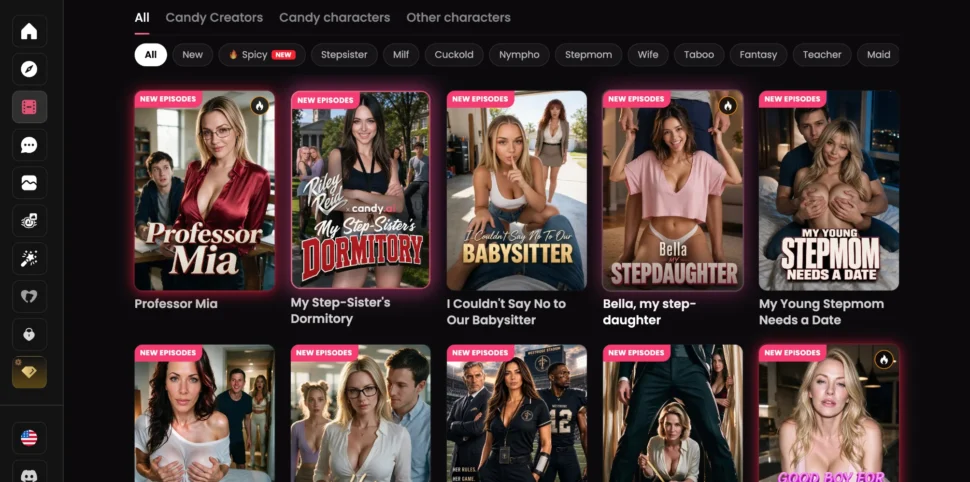
The feature is called Shorts: vertical, full-screen clips you swipe through the way you swipe TikTok, organised into Series that get new instalments over time and star the platform’s own recurring companions. Some are open, some sit behind a “Sign up to view” card. We break down how Candy AI Shorts works, how many episodes are free and whether it carries the Premium plan in the full review.
Look at that filter row again, though, because it tells you how the catalogue was built. Those are not genres. They are the tag taxonomy of every tube site on the internet, lifted wholesale. Nobody sat in a writers’ room and arrived at “Stepmom” as a creative direction. The catalogue is assembled from search demand, and the titles are written to match queries rather than everything. That is not a criticism of the execution, which is genuinely slick. It is a description of the method.
The mechanic that actually matters
Here is the part worth understanding: when an episode ends, you can message the star.
That single line reorganises everything. Netflix’s asset is the show. finished the episode, Netflix’s only move is to autoplay another show, and it has to keep buying shows forever. Here the show is not the asset at all. The character is the asset, and the episode is a three-minute advertisement for her.
And because these are the platform’s own companions rather than licensed strangers, every minute of watch time is building recognition for something they own outright and can sell for as long as it exists. A viewer who watches four AI porn shorts in a row has not consumed a product. They have been introduced to a character they now want to talk to, generate NSFW images of, and keep. That is the whole funnel, and it is a much better one than “here is a chat box, invent someone.”
It also solves a problem this category has had since it started: discovery. Asking a new user to imagine a character from nothing is a terrible onboarding step. Handing them a stepmom drama with a face already attached is a much easier one. We wrote about the underlying shift toward characters that persist in the persistent-character era. Shorts are what happens when those persistent characters get a marketing budget.
Nobody invented this, and that is the point
The instinct is to read AI shorts as an AI story. It is not. It is a format transplant, and the format it comes from is enormous.
Vertical microdrama, the phone-native serial format built out of 60 to 90 second episodes strung into runs of 60 to 100, has gone from a curiosity to one of the fastest-growing categories in mobile entertainment. Short drama apps pulled roughly $2.98 billion in in-app purchases across 2025, up about 115% year on year, and Deloitte projects in-app microdrama revenue of around $7.8 billion in 2026, more than double the year before. ReelShort alone is around $1.2 billion with 70 million-plus monthly users; DramaBox sits near $323 million with 50 million-plus. There are some 331 microdrama apps live in 2026, with the top three taking roughly 60% of revenue outside China.
So when an adult AI platform ships a swipeable episodic feed, it is not experimenting. It is porting a proven, multi-billion-dollar playbook into a vertical where the same audience behaviour already exists. The surprise is not that it happened. It is that it took this long.
With one modification, and it is the modification that makes the adult version stronger. Microdrama apps sell you the next episode. That is the business: coins, unlocks, a cliffhanger every ninety seconds and a paywall at episode nine. AI companion platforms mostly do not need to do that, because the episode is not the product. They can afford to give the content away, because they are selling the subscription behind it. A microdrama app that gives away episode ten has lost money. An AI platform that gives away episode ten has acquired a user.
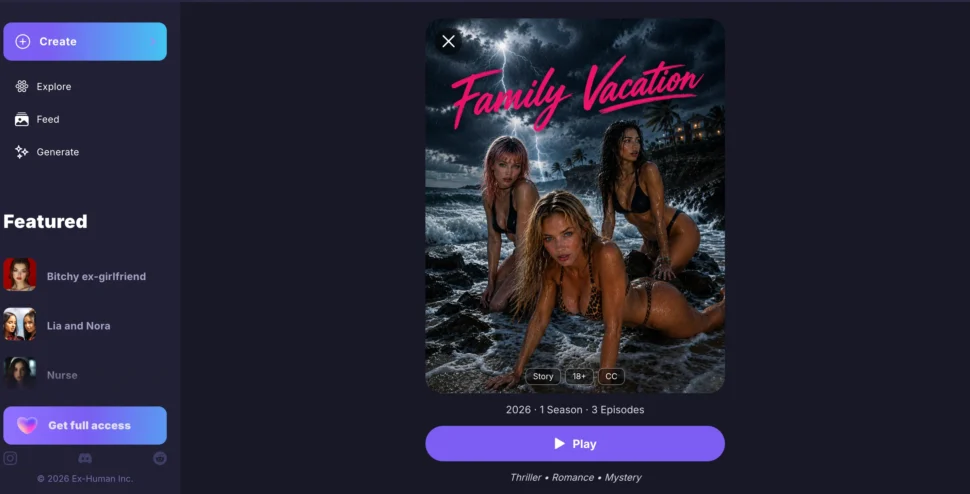
Update 09/14/2026
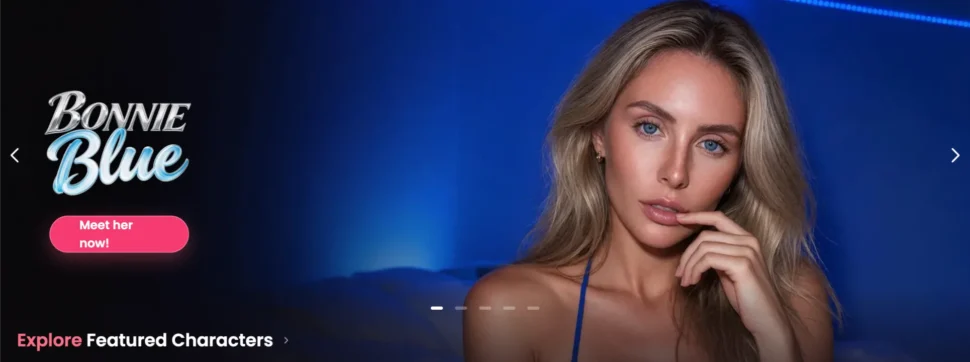
Candy Shorts has just added none other than Bonnie Blue to its roster of big names in the industry, and of course, her digital twin’s debut in a dedicated miniseries titled “Student Bodies” was a must; there’s no need to reveal the plot – if you know anything about the character, you already know what challenge she took on. I can’t wait to see who else will join the team, and needless to say, I love this trend and I hope it doesn’t stop now.
Update 10/14/2026: Candy Studio, the Candy Shorts you direct yourself
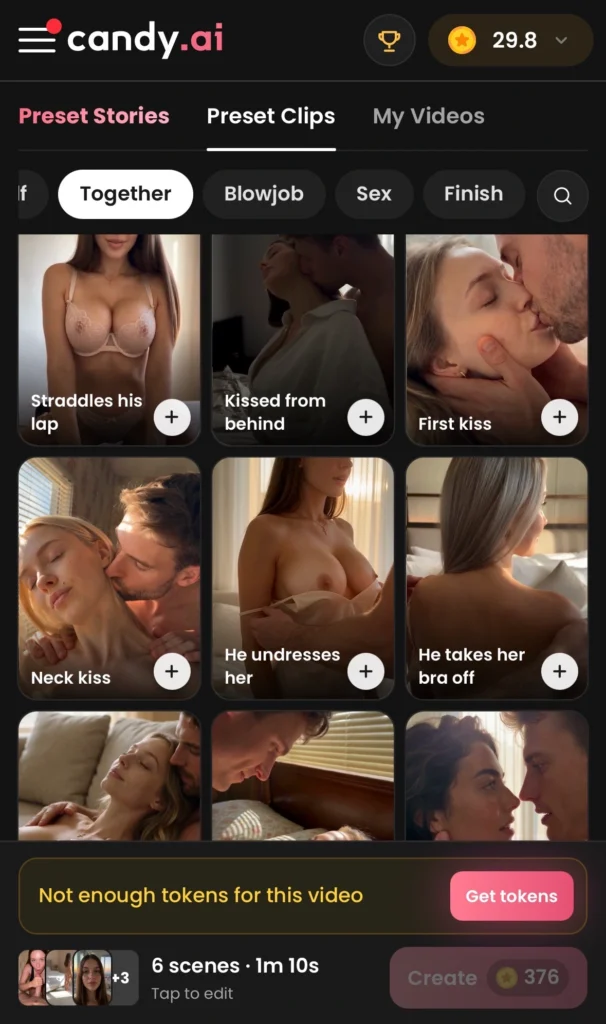
When I wrote this piece in September, my point was that the character is the product and the episode is the advert. Candy has now handed the advert to the viewer. It is called Candy Studio, the tagline is “build your own spicy movie”, and my first reaction after trying it was simple: this is absurd.
You pick the girl, creators included (yes, the Riley Reid twin from the flagship series, at the same token price as any regular character), pick the location, then lay the episode out like a film editor. Short preset clips, each one 5 to 20 seconds, sorted into phases that read like a script: arrival, story, alone, tease, touching herself, together, and from there the explicit acts. Candy stitches the pieces into one continuous take, as if someone had done the post-production for you. Don’t fancy a blank page? Preset stories give you the classic setups already cut together, ready to tweak.
Why it matters beyond the novelty: further down I argue that AI video still falls apart after about a minute. Studio sidesteps the problem instead of solving it. Every clip stays short, and the stitching makes them play as one. My first episode ran a minute and a half and held together.
The viewer has just become the producer. The full walkthrough, including what an episode costs in tokens, is in our review: how to make your own AI porn movie with Candy Studio.
Build your first episode in Candy Studio →


And it is not just Candy..
Botify.ai runs the same structure under a different name and a very different shelf. Its Experiences row is a carousel of poster cards with Watch buttons, filtered by Recommended, Featured, Flirting, Anime, Game, Fictional and Horror, with titles like The Last Perfect Day, Thorns & Horns, Tenure and Pretty Deadly. Crime, gothic fantasy, campus noir. The posters would not look out of place on a genre streaming app.
That contrast is worth sitting with. Candy builds its catalogue out of porn-parody tropes; Botify builds its out of genre fiction. Same format, same underlying trick of using your own character roster, completely different positioning. Which tells you the format is not tied to the tropes, and a format that generalises is a format that spreads. It already has. Secrets.ai runs weekly mini-dramas, Swipey.ai buries them inside the chat, OurDream.ai uses them as an opening scene, and Lovescape skipped the short format altogether for full-length video. Five of the best AI porn shorts sites, four different answers to the same idea.
The cost argument, done properly
The obvious take is that AI series are cheaper than shooting porn. True, and not the interesting part.
A conventional scene carries performer day rates, a crew, a location, direction, post-production, and the record-keeping obligations that come with filming real people. An AI episode carries a prompt and some compute. Fine. But that comparison is about episode one, and episode one is not where the money is decided.
The real gap is marginal cost. A studio pays roughly the same to make its fortieth scene as its first. These platforms do not. Once the character exists and the pipeline works, episode forty costs what episode one cost in compute and nothing else. There is no scheduling, no performer availability, no reshoot, no travel. If a trope starts trending on a Tuesday, a catalogue can respond that week rather than that quarter. Nothing in traditional adult production moves at that speed, and no amount of budget makes it.
That is a structurally different business, not a cheaper version of the same one. Whether it justifies a subscription on its own is a separate question, and one we answer for the platform that started this in our Candy.ai review.
Opening scenes: one clip, then the chat is yours
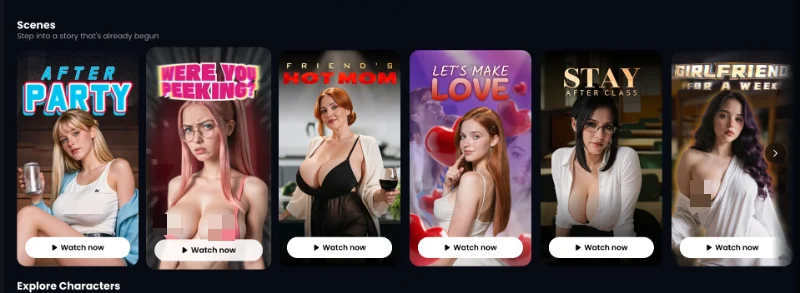
Some platforms are skipping the series altogether and keeping it to the origin with a twist: the start chatting. An opening scene is a short vertical video, thirty seconds to a minute long, that plays before you open the chat and: It shows you who she is, where you are and what has just happened, then it stops and leaves the next line to you; a real setup.
None of the ones I watched is really explicit, and they don’t need to be. A bio and a profile photo ask you to imagine the character; thirty seconds of watching her in the situation does that job for you, so your first message already has a scene behind it. The chat starts several messages further in than one that opens on “hi”, and it heats up sooner because of it.
It is also the cheapest version of the funnel described above. A series needs several episodes per character. An opening scene needs one clip, and it ends exactly where a short ends anyway: at the moment you start talking to her.
Who is doing it right now:
- OurDream.ai has the most complete version: a shelf called Opening Scenes on the home page, ten scenes at the moment, 45 to 60 seconds each, with sound and English subtitles. Each one closes on “The scene is set. Your move.” and the chat picks up from there. Watch an Oi urDream opening scene →
- Bonbon.ai runs a Scenes row (“Step into a story that’s already begun”) with eight 30-second clips, all made in-house. Start chat opens the conversation inside that scene, and seven of the eight are tagged Slow Burn: the video does the warm-up, the chat keeps its pace. Watch a Bonbon scene →
- GirlfriendGPT is earlier in. There is no dedicated row yet: for now a 30-second video intro sits on a couple of POV scenario characters, and the older of the two has passed 53,000 chats since it went live on September 4. Try GirlfriendGPT →
Three platforms so far. As more of them ship their own version, we will add them here.
So is this the overtaking point?
Partly. Let me split it, because the honest answer is different in each direction.
On attention: close to it, or already there. The format is proven at eight-billion-dollar scale in mainstream entertainment, and adult verticals have historically adopted and monetised new formats before the mainstream finishes arguing about them. The thing competing for the twenty minutes you used to spend on a tube site is now a swipe feed with a chat window attached to it.
On craft: not yet, and it is not close. These are shorts. Sixty seconds, sometimes a few minutes. The posters are doing an enormous amount of work, and a poster is not a scene. Nobody has shipped a watchable twenty-minute AI production with consistent bodies, consistent lighting and continuity that survives a cut. The format currently chosen happens to be exactly the length at which AI video stops falling apart, and treating that constraint as a creative decision is the one piece of marketing in all of this that should not go unchallenged.
On what the industry actually sells: the collision is happening somewhere else than people think. Adult’s product stopped being “video” years ago. It became access and parasocial connection, which is the entire creator-subscription economy. That is precisely what these platforms sell, and they sell it with a character who answers instantly, never has a bad day and costs nothing to keep. AI shorts are not aimed at studios. They are aimed at the subscription you already pay a person for.
And then there is the piece of evidence that cuts hardest against the replacement thesis, sitting right in the middle of Candy’s own catalogue: the flagship series is branded Riley Reid x candy.ai. The biggest title in the shop is a licensing deal with a real performer.
Read that carefully. If AI had genuinely displaced the value of a recognisable human face, you would not pay for one. The winning move so far is absorption, not replacement: buy the name, generate the volume. That is a much more plausible near future than studios going dark, and it is a considerably better outcome for the handful of performers with names worth licensing than for everyone else in the industry.
What to watch next
- Runtime. The moment anyone ships a coherent ten-minute AI episode, the craft objection above expires.
- Whether anyone starts charging per episode. If a platform paywalls episode nine, it has stopped competing with porn and started competing with ReelShort, which is a much harder fight against much better-funded incumbents.
- More licensing. One performer deal is an experiment. Five is a business model, and it tells you which way this actually goes.
- Whether the tag taxonomy ever breaks. Every catalogue right now is built from tube-site search terms. The first platform that commissions something because it is good rather than because it ranks will be worth watching.